The day after the election last week the market was up. But on Thursday the day after, the market was down about 4%. Should investors be worried that the market is going to crash, despite some positive days since then?
This week in their Weekly Market Recap, JP Morgan, one of the Portfolio Strategists we utilize for client accounts, wrote the following about this issue…
Following Democratic victories in both the House and Senate, investors initially welcomed the prospect of reduced political uncertainty. However, attention quickly shifted to the implications for artificial intelligence, with several newly elected state and local officials advocating for slower deployment and increased regulation. Given the market’s heavy reliance on the AI buildout theme, this shift in sentiment weighed heavily on equities, pushing the VIX to levels not seen since April and triggering the S&P 500’s largest single day decline in more than a year.
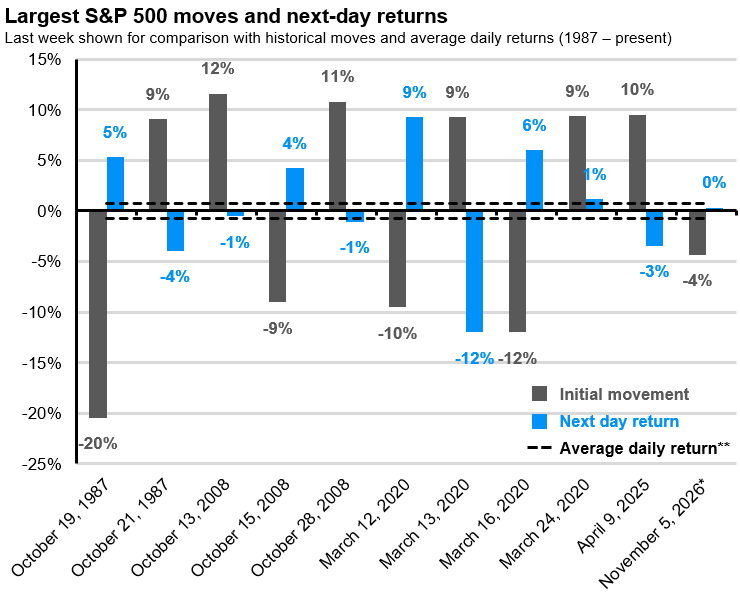
This week’s chart examines the ten largest daily moves in the S&P 500 over the last four decades and what happened the following day. While the initial swings were dramatic, they were often followed by a meaningful reversal, highlighting how quickly sentiment can change during periods of market stress. These reversals were typically much larger than the market’s average daily move, illustrating that some of the market’s strongest gains have occurred immediately after steep declines, while some of its sharpest pullbacks have followed powerful rallies. While Thursday’s selloff grabbed headlines, it remains well short of many of the historic declines shown in the chart, all of which were ultimately overcome as markets recovered and moved higher over time.
History shows that large market moves are often followed by meaningful moves in the opposite direction, making it extremely difficult to time the market. Investors who react to large one day moves risk missing subsequent rebounds or recoveries. Maintaining a disciplined, long-term approach has typically been more effective than attempting to trade around short-term shocks. While volatility can make for an uncomfortable ride, investors have generally been rewarded for staying buckled into the helicopter rather than jumping out in the middle of the turbulence.